The wood-stove first-fire ledger
Before the first cold night, verify the whole heating path: dry fuel, appliance and flue, clear space, working alarms, safe ash storage, an exit plan, and a backup another person can use.
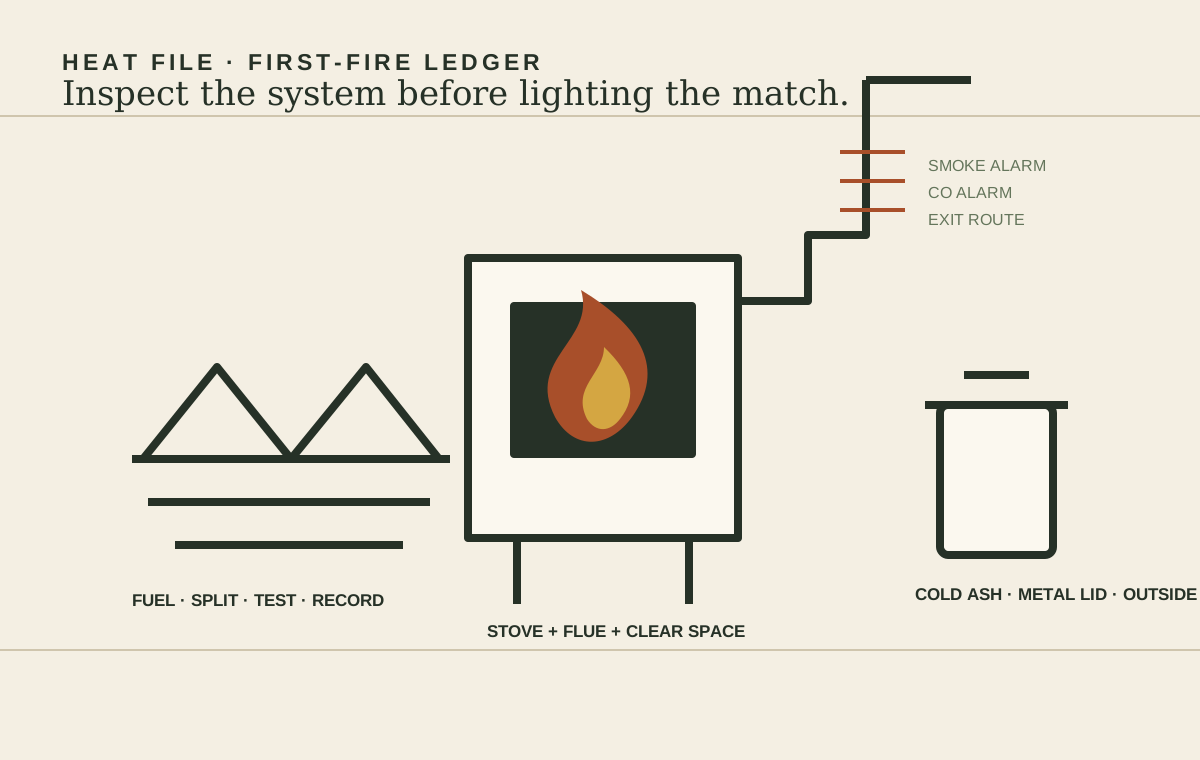
Cold weather turns small uncertainties into urgent decisions. A stove that has not been inspected, a chimney with an unknown service history, fuel bought on a verbal promise, or an alarm with an uncertain battery is not a heating plan yet. The first-fire ledger makes those unknowns visible while there is still time to call a professional, replace equipment, or arrange other heat.
Autumn public discussions from new and returning wood-stove users concentrate on the same questions: Is the wood actually dry? Where does a thermometer belong? How much creosote is too much? Is the first fire safe to leave overnight? Those questions are equipment-specific. The stove and chimney manuals, listing requirements, local code, fire officials, and a qualified chimney professional must govern the answers. A generic internet setting or temperature cannot safely replace them.
Do not light the appliance if the installation, chimney condition, clearances, connector, door, gasket, controls, or fuel requirements are unknown or visibly damaged. Do not climb a roof, improvise a chimney repair, bypass a safety device, modify the appliance, or test a suspect system with fire. Arrange qualified inspection and follow the appliance and venting manuals.
Make one record for the entire heat path
Start at the wood stack and end at the outdoor ash container. Photograph nameplates and the installation from several angles, then record documents and dates. The goal is not to certify the system yourself. It is to identify who verified each part and what instructions the household must follow.
| Ledger section | Record before the first fire | Why it matters |
|---|---|---|
| Appliance | Manufacturer, model, serial, manual location, fuel allowed | Operating limits and maintenance are model-specific |
| Venting | Chimney and connector type, professional inspection and cleaning date, open repairs | The full exhaust path must safely carry combustion products outdoors |
| Room | Required clearances, floor protection, nearby combustibles, exit path | Ordinary storage can quietly move into unsafe space |
| Fuel | Species or mix, source, split size, storage, fresh-split moisture readings | Wet fuel contributes smoke and poor combustion |
| Detection | Smoke and carbon-monoxide alarm locations, test date, replacement date | Alarms provide warning when combustion or venting fails |
| Ash | Metal container with lid, outdoor location, path from stove | Hidden embers can ignite nearby material |
| Backup | Alternate heat, safe-room plan, outage dependency, responsible operator | A stove problem should not force unsafe improvisation |
Close the inspection gap first
The U.S. Fire Administration tells households to have chimneys inspected and cleaned each year by a professional. Put the report date and any follow-up work in the ledger. “Swept” and “inspected” answer different questions: cleaning removes deposits, while inspection addresses condition, compatibility, damage, obstruction, and the installation as a system.
Bring the appliance manual, chimney or liner documentation, previous service records, and photos to the appointment. Ask the professional to identify the next service interval and conditions that should trigger an earlier check. Heavy use, a change in fuel, operating trouble, smoke spillage, a suspected chimney fire, water entry, storm damage, or alteration may justify attention before the next calendar reminder.
Look from the floor for obvious changes without disassembling anything: loose or corroded connector sections, cracked glass, damaged firebrick, missing fasteners, a deteriorated door seal, staining, debris, water, or objects stored close to the appliance. Record the observation; let the manual and a qualified professional determine the repair.
Rebuild the three-foot clear zone
USFA recommends keeping anything that can burn at least three feet from a fireplace or wood stove. Use that minimum as a room audit, while honoring any larger model-specific or code-required clearance. Check every side and the path in front of the loading door.
- Move firewood, kindling, paper, furniture, rugs, curtains, drying clothes, pet beds, baskets, toys, and seasonal decorations out of the required zone.
- Confirm that the hearth or floor protection matches the appliance documentation and has not been covered or damaged.
- Keep the loading and ash-removal route free of trip hazards.
- Do not use the appliance or connector as a drying rack.
- Show every operator which nearby materials count as combustible.
Clearance is not a one-time installation measurement. Homestead rooms change through the season. Add a quick visual check to the daily chore list so boots, gloves, feed sacks, laundry, and split wood do not migrate back toward heat.
Test fuel claims with a repeatable sample
The EPA ended active updates to its Burn Wise program in 2025, but its archived technical education remains useful: dry, seasoned wood at 20% moisture or less burns best, and moisture should be checked with a meter on a newly split face. Treat that number as general fuel guidance; use the appliance manual for its fuel requirements.
- Bring representative pieces to the meter's specified testing temperature and follow the meter instructions.
- Select pieces from different parts of the stack, including large and small splits.
- Split each sample immediately before testing.
- Place probes on the newly exposed interior face as the meter maker directs, accounting for species settings if required.
- Record the date, stack location, sample count, and individual readings rather than one favorable result.
A seller's use of “seasoned” or “kiln dried” is not the same as a measured result for the wood delivered. If samples are too wet for the stove's requirements, do not solve the shortage by burning them anyway. Separate the stack, improve covered airflow without trapping moisture, and arrange suitable fuel or backup heat.
Fuel file / sample record
- Delivery or stacking date
- Source and species if known
- Covered top and open sides
- Split size and stack location
- Meter make and settings
- Fresh-split readings
- Fuel accepted or held back
- Next check date
Verify alarms and the household response
CDC's winter-storm guidance says a home using a fireplace, wood stove, or kerosene heater should have a smoke detector and a battery-operated carbon-monoxide detector near the heated area. Follow current alarm manufacturer instructions, local code, and fire-department guidance for exact placement, interconnection, testing, batteries, and end-of-life replacement. Do not place an alarm based only on a generic distance copied from another model.
Press each test control as instructed and record the result. Check manufacture or replacement dates. Make sure the signal can wake sleeping occupants and be perceived by people with hearing, vision, mobility, or cognitive needs. Plan who helps children, older adults, visitors, and animals leave.
If a carbon-monoxide alarm sounds, someone has symptoms, smoke enters the room, or a chimney fire is suspected, move people to fresh air, leave the building, and call 911 or the fire department from outside. Do not re-enter or relight the appliance until emergency officials and qualified professionals say it is safe. The ledger should list the property address, gate details, and meeting point; link those details to the farm emergency map.
Stage ash handling before making ash
USFA advises placing fireplace and wood-stove ashes in a metal container with a lid and keeping that container outdoors at least 10 feet from the home. Choose a stable, noncombustible location away from buildings, decks, porches, firewood, dry vegetation, feed, vehicles, fuel, and animal access. Follow local fire rules, which may require more separation or different disposal.
Map the route from the appliance to that container. It should not require stepping over clutter, passing close to combustibles, or setting a hot tool on a wood floor. Use the appliance's specified tools and ash procedure. Never put ash in a cardboard box, plastic pail, paper bag, trash bin, compost pile, garden bed, or vacuum while embers may remain. Cold-looking ash can conceal heat.
Run the first fire as a supervised systems check
The first fire is not the moment to experiment with an overnight load. Schedule it when a capable operator can remain present, outdoors is calm enough for normal operation, and backup heat is available. Follow the manual's startup instructions, allowed fuel, loading limits, air-control sequence, catalyst procedure if applicable, break-in directions, and temperature-monitoring locations.
Before ignition, record:
- professional inspection or service complete and open defects resolved;
- manual open to the startup page;
- required clearances restored;
- smoke and CO alarms tested;
- approved extinguisher available and household members trained according to fire-department guidance;
- ash container ready outdoors;
- children, visitors, and animals kept from the hot zone;
- backup heat available if the test stops.
During the supervised fire, note ignition time, outdoor conditions, fuel samples, load described by the manual, control changes, draft behavior, visible smoke spillage, unusual odor after any expected manufacturer-described break-in period, alarm activity, and surface or flue readings only at the locations and with the instruments the manual specifies. Do not transfer thermometer locations or operating ranges from another stove.
If operation differs from the manual, an alarm activates, smoke enters the room, the appliance or connector glows, controls do not respond, or anything appears unsafe, follow the manufacturer's emergency procedure if it can be done without exposure, evacuate, and call the fire department. Do not use water on a stove or chimney fire unless emergency officials specifically direct it.
Link heat to the rest of the homestead
Wood heat changes other systems. A stove may keep one room warm while pipes, stored medicines, incubators, pumps, livestock water, or distant bedrooms still freeze. Fans, pumps, alarm interconnection, and communications may depend on electricity. Record those links in the outage dependency map and compare the heating plan with the first-freeze water audit.
Choose a safe-room temperature plan, a pipe-protection plan designed to code, and an alternate place for people or animals if heat fails. Never move a grill, camp stove, generator, or other outdoor combustion device indoors or into a garage. CDC warns that carbon monoxide is colorless and odorless; generator exhaust can kill without warning.
Keep a short operating ledger all season
A one-line daily record can reveal a change before it becomes a crisis. Record the date, operator, fuel sample or stack, approximate load, relevant manual-defined readings, smoke or odor observations, alarm status, ash removal, and any change in draft or controls. Make a service call when the pattern changes instead of inventing a new operating technique.
Review the full file after a chimney service, repair, severe storm, suspected overfire or chimney fire, fuel change, alarm replacement, or change in household operators. At season's end, close the ledger with remaining dry-fuel quantity, repairs due, service booked, ash container condition, and the earliest date next year's wood must be stacked.
Sources
Reviewed October 8, 2026. Appliance and venting manuals, local code, fire officials, and qualified professionals control the site-specific plan.
- U.S. Fire Administration — Heating Fire Safety.
- U.S. Fire Administration — Fireplace and Wood Stove Safety.
- U.S. Environmental Protection Agency archived Burn Wise guidance — Test Your Wood with a Moisture Meter.
- U.S. Environmental Protection Agency — Wood Smoke and Your Health.
- Centers for Disease Control and Prevention — Preparing for a Winter Storm.
- Centers for Disease Control and Prevention — Generator Safety and Carbon Monoxide.