The first-freeze homestead water audit
Walk every branch before the cold arrives: protect seasonal irrigation, verify winter livestock water, mark shutoffs, and record a backup that another person can run.
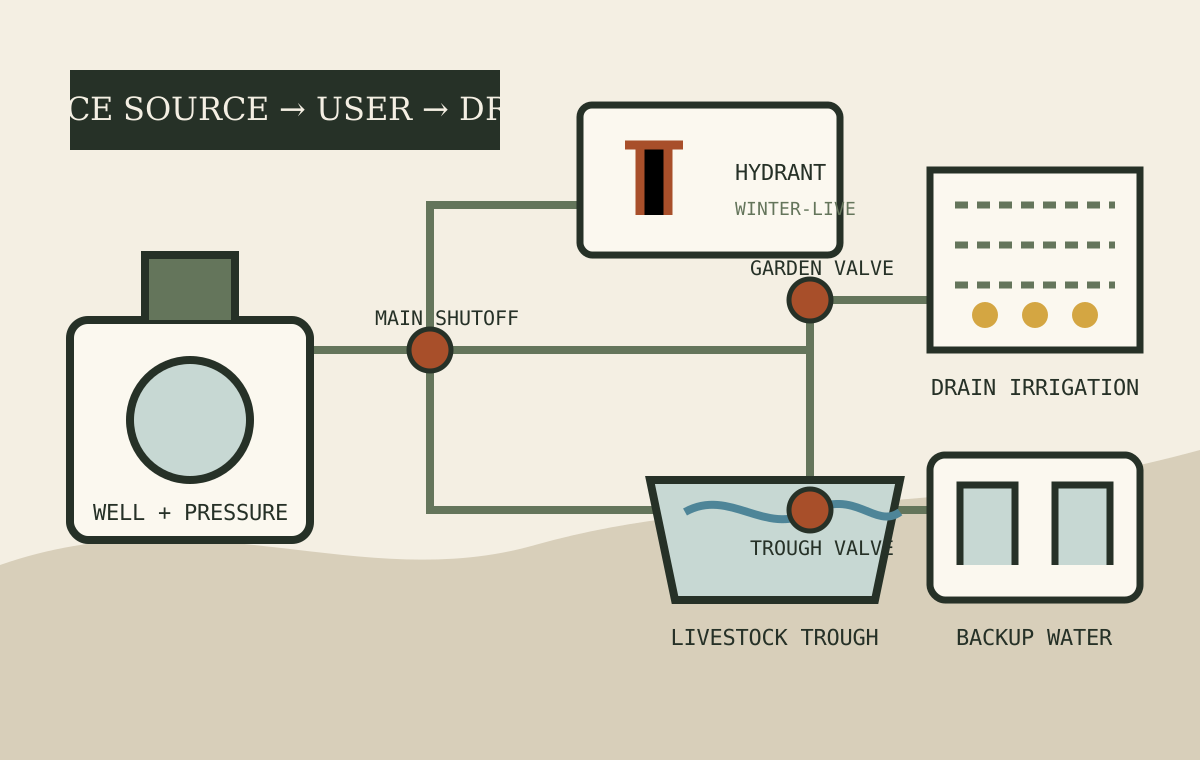
A first-freeze water audit is not a promise that nothing will fail in January. It is a controlled walk-through while valves still turn, soil is not frozen, daylight lasts long enough to make a repair, and a second water source can be arranged without carrying buckets across ice.
The useful unit is not “the well” or “the trough.” It is a complete path: source → power or pressure → pipe → valve → delivery point → drain or overflow → animal, crop, or household use. Follow each path physically. Photograph what you find and write down who can operate it.
Do not open electrical panels, bypass protection, enter confined spaces, climb unstable roofs, pressure-test unknown plumbing, or improvise heaters and wiring. Follow the equipment manual, local plumbing and electrical codes, and qualified professional advice. Keep people and animals away from exposed wiring, unstable ice, open wells, and pressurized leaks.
Start with the forecast and the operating plan
Use local weather forecasts, not a fixed calendar date. Choose a deadline before the first sustained freezing period and leave time for parts, professional service, and a retest. Then divide the system into three categories:
- Winter-live: household supply, livestock water, fire protection, greenhouse water, or another branch that must operate in freezing conditions.
- Drain and store: drip irrigation, soaker hoses, garden timers, filters, regulators, portable tanks, wash-down hoses, and seasonal plumbing not designed for freezing weather.
- Conditional: a line used only during a warm spell, emergency, or supervised chore. Its safe startup and shutdown must be written.
Penn State Extension’s winter farm guidance recommends making a checklist, setting deadlines, inspecting water lines, hoses and floats, and arranging backup options for heat and water. The point of classification is to stop treating every pipe the same.
Draw the map from source to drain
Mark the primary source—well, public water, spring, cistern, hauled water, or another approved supply. Then add pumps, pressure tanks, filters, treatment equipment, shutoffs, buried and exposed lines, hydrants, float valves, troughs, wash stations, irrigation headers, and drains. Record the power source and any control that can fail independently.
| Ledger field | What to record | Why it matters |
|---|---|---|
| Source | Type, location, normal capacity information, access | Defines the start of each water path |
| Control | Shutoff, breaker identifier, pump switch, timer, float | Allows a safe stop or isolation |
| Exposure | Aboveground pipe, low point, draft, shallow burial, hose, wet area | Shows likely freeze or ice locations |
| User | People, animals, greenhouse, sanitation, garden | Sets consequence and priority |
| Drainage | Where leaked, overflow, rinse, rain, and snowmelt water go | Reveals ice, mud, and contamination risks |
| Backup | Alternate source, stored volume, containers, transport, labor | Tests whether the written plan can actually work |
Label the main shutoff and critical branch valves in the field and on the map. Use names that another person can match: “north barn hydrant,” not “the blue one.” If a valve is buried, inaccessible, leaking, or unfamiliar, arrange service before freezing weather rather than forcing it during an emergency.
Drain the garden branch deliberately
Iowa State University Extension’s current drip-irrigation guidance says drip systems and soaker hoses should be drained before winter to reduce freeze damage. It recommends disconnecting from the source, removing components such as pressure valves, timers, regulating disks, and backflow preventers, storing those components indoors, removing end caps, and lifting lines so low areas drain.
Walk the system from high point to low point. Water can remain in a sag even when the end looks empty. Give the system time to drain and loosely replace clean end caps after it is dry enough to keep debris and animals out. Coil movable tubing without tight kinks and label its bed or zone before storage.
Compressed-air winterization is equipment-specific. Iowa State notes that manufacturer guidance determines appropriate pressure and that excessive pressure can damage emitters and delicate parts. If you do not know the component limits or procedure, use a qualified irrigation professional rather than improvising.
Verify every winter-live livestock path
Clean water remains essential in cold weather. Colorado State Extension warns against assuming livestock can meet water needs by eating snow or licking ice, and notes that needs vary with species, size, physiological state, activity, diet, water quality, and temperature. A winter plan should be based on the animals present and advice from your veterinarian or Extension livestock specialist.
For each waterer:
- Count animals and record the current group, not last winter’s group.
- Observe normal refill from a known drawdown and record the result.
- Inspect the float, valve, protective housing, drain, and exposed hose or line.
- Look for leaks that create ice around gates, alleys, feeders, electrical equipment, or the drinking edge.
- Confirm the winter method—frost-protected design, supervised refilling, approved heater, or another system—and the exact operating instructions.
- Write the backup quantity, containers, transport route, labor, and refill source.
Penn State’s 2026 overview of livestock watering facilities emphasizes matching the system to animal water needs, source, pump and winter use. Tank size alone is not reliability: recharge rate, travel distance, frozen controls, and the ability to reach the water all matter.
Treat heaters and deicers as a full electrical system
A water heater or deicer adds dependencies: the correct device, compatible waterer, protected power, sound cord, safe routing, secure animal exclusion, and routine inspection. Follow the manufacturer’s instructions and local code. Use only equipment approved for the intended location and application. Have a qualified electrician address receptacle protection, circuit suitability, damaged wiring, repeated trips, warmth, corrosion, or uncertainty.
Protect cords and equipment from chewing, rubbing, machinery, bedding, standing water, and ice. Do not use an improvised extension-cord arrangement as a permanent farm wiring solution. Switch off and service equipment according to its instructions; never reach into electrified water when a fault is suspected.
Check the ground around the water
A technically working trough can still produce an unsafe winter chore if overflow freezes across the approach. Inspect grading, roof runoff, downspouts, waterer pads, animal traffic, and the route used to carry emergency water. University of Minnesota Extension notes that thawing and refreezing can create hazardous icy areas for people and livestock and advises directing runoff away from animal yards, feed storage, buildings, and high-traffic areas.
Small fixes include repairing a float leak, clearing a drain path, extending a downspout away from the approach, moving stored items out of the emergency route, and adding appropriate traction material according to the site and animal needs. Larger grading and drainage work should be designed with local conservation, engineering, and permitting guidance.
Test the backup as a chore, not a sentence
“Haul water” is not yet a plan. Complete a safe tabletop calculation and a limited dry run:
- Which approved source remains available if the main source or power fails?
- How much water is required for the household and each animal group over the planned interval?
- Which clean, food- or water-appropriate containers are available?
- Can they be filled, lifted, secured, transported, poured, and cleaned by the assigned people?
- What route remains passable during snow, ice, mud, darkness, or a closed gate?
- Who is the second person if the usual operator is unavailable?
Do not use a container with an unknown chemical history. Do not rely on a pond or surface water without professional guidance on quality and access. Direct livestock access to streams and ponds can damage banks and water quality and introduce animal-safety problems; plan controlled facilities with Extension or conservation professionals.
For poultry systems, connect this water plan to the winter chicken-coop ventilation ledger, since a leaking or heated waterer changes both moisture and power needs.
Run the ten-minute freeze morning check
- Read the current local forecast and alerts.
- Check source power, pump or pressure indication without defeating covers or safeguards.
- Observe each winter-live delivery point and normal refill.
- Look for leaks, slow flow, unusual cycling, ice, wet bedding, and damaged cords.
- Confirm that animals are drinking and that access is not blocked.
- Drain any temporary hose immediately after its approved use.
- Record the observation, temperature, action, and person.
A short written check makes trends visible. Slow refill on three cold mornings is information; a frozen system on the fourth morning is an emergency.
Close the season with a one-page ledger
Water file / minimum record
- Map revision date and operator names
- Winter-live and drained branches
- Valve, breaker, and control labels
- Animal groups and water-demand source
- Normal refill observation and date
- Heater or deicer model and manual location
- Backup source, containers, route, and labor
- Known repairs, owner, deadline, and retest
Link the ledger to the site’s outage dependency map, because pumps, heat tape, well controls, and trough heaters may share electrical dependencies. Add water points and alternate access to the farm emergency map so a helper or responder can understand the property under pressure.
Sources
Reviewed September 27, 2026. Local Extension, veterinarians, conservation professionals, equipment manuals, and codes should shape the final plan.
- Iowa State University Extension — Using Drip Irrigation in the Garden.
- Penn State Extension — Dairy Farm Preparation to Avoid the Winter Woes.
- Penn State Extension — An Introduction to Watering Facilities.
- Colorado State University Extension — Winter Water for Livestock and Horses.
- University of Minnesota Extension — Plan Ahead to Manage On-Farm Snowmelt.