Private well in a winter power outage: build the water ledger
A private well can hold plenty of water underground and deliver none at the tap when electricity stops. Trace the whole system now—then put stored water, livestock chores, freeze protection, and safe backup power on one tested page.
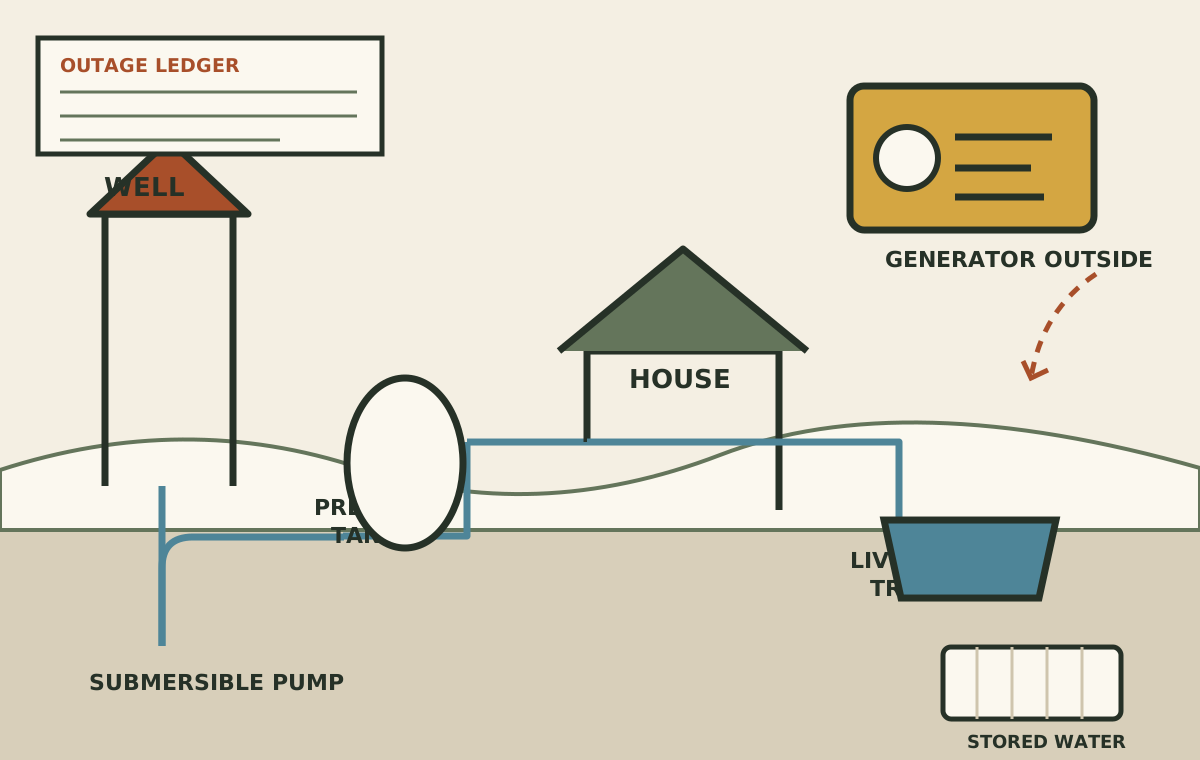
The common surprise is not that a well pump needs electricity. It is how many separate jobs depend on that pump: drinking, cooking, handwashing, toilets, animals, milk-room cleanup, medication, fire protection, and sometimes heat. A pressure tank may briefly keep a faucet running, but it is not a dependable multi-day reserve. Once pressure falls below the switch setting, the pump must run before the system can recharge.
Winter adds another clock. A pump house, shallow service line, hose, float valve, trough, or exposed fitting can freeze while the grid is down. Roads may be poor just when hauling water becomes necessary. NOAA’s October 2026 winter outlook favors wetter-than-average conditions across the southern tier and East Coast and drier conditions in parts of the northern Mountain West, but a seasonal outlook is not a property forecast. Every region can still have a damaging cold spell, ice event, windstorm, or outage. Build the plan from local records and your own system.
Do not open a well cap, enter a well pit, touch wet or damaged electrical equipment, backfeed a building, improvise a transfer connection, thaw pipe with flame, or alter a pressure system from this guide. Use a licensed well contractor and qualified electrician, follow local codes and equipment manuals, and contact your health department when water safety is uncertain. Carbon monoxide is invisible and can kill people and animals; generators belong outdoors, well away from doors, windows, vents, and animal housing.
Map the system before naming a solution
Start with records, not a generator advertisement. Find the well log, pump invoice, control-panel label, pressure-switch settings, pressure-tank model, breaker size, water-treatment equipment, service-line route, and the contractor who last worked on the system. If records are missing, write “unknown” rather than guessing. Ask the well contractor or state well program how to obtain a well record.
Draw the water path from aquifer to each critical outlet. Include the well casing and cap; pump type and depth; control box; electrical disconnect; pressure switch and tank; filters, softeners, ultraviolet treatment, or other equipment; hydrants; livestock lines; heated waterers; cisterns; drain points; and any branch that crosses an unheated space. Add the septic or wastewater system because conserved supply water still has to go somewhere.
| Ledger line | Record now | Why it matters in an outage |
|---|---|---|
| Well and pump | Well ID, depth, pump model, voltage, phase, horsepower, date, contractor | Determines who can service it and what qualified backup design must start |
| Pressure system | Tank model, switch settings, usual cycle, gauge reading | Shows normal behavior and makes a change easier to recognize |
| Treatment | Equipment order, electrical needs, bypass instructions from installer | Powering the pump alone may not restore safe treated water |
| Critical outlets | Household, animals, milk room, greenhouse, fire plan | Turns a vague need into prioritized gallons and delivery routes |
| Freeze points | Unheated rooms, shallow lines, hoses, valves, drains, wind exposure | Identifies parts that need a qualified cold-weather procedure |
| Backup equipment | Stored water, containers, pump, generator, transfer equipment, fuel | Separates owned equipment from a tested working system |
Take photos of labels and keep paper copies where a caregiver can reach them without internet access. Link the map to the site’s broader outage dependency map and mark the well shutoff on the farm emergency map. The same page should name the utility, electrician, well contractor, health department, certified laboratory, veterinarian, and a water-hauling source that has agreed to serve the property.
Build a water budget from chores, not one round number
Emergency guidance often begins with drinking water for people. A homestead plan has to continue from there without blurring potable and nonpotable uses. Use a safe drinking-water allowance for every person, then separately list cooking, hygiene, medically necessary use, sanitation, animals, food handling, and essential cleaning. Ready.gov’s general starting point is at least one gallon per person per day for several days, with more for children, nursing people, illness, hot climates, and pets. That is a baseline, not a complete homestead total.
For animals, use current species- and production-specific guidance from your veterinarian or local Extension office. Water intake changes with body size, ration moisture and salt, lactation, temperature, activity, health, and access. Do not assume snow replaces water. South Dakota State Extension notes that electrical outages can interrupt heated livestock water systems and that generators are not fail-safe; Nebraska Extension warns that snow may not provide enough usable water, particularly when crusted or trampled.
Measure real use on an ordinary cold day. Record container size, number of fills, spillage, travel time, lifting, and the route from storage to the animal. Repeat on a day when a helper does the chore. That second run often reveals the real constraint: a gate that will not open, a frozen hose, a container too heavy to carry, or no safe way to move water over ice.
Daily outage water worksheet
- People: safe drinking and cooking water
- Medical and accessibility needs
- Handwashing and essential hygiene
- Toilet and sanitation plan
- Each animal group and head count
- Food or milk handling requirements
- Critical cleaning and biosecurity
- Container and delivery losses
- Freeze margin and one delayed refill
- Total gallons, weight, trips, and labor
A U.S. gallon weighs about 8.34 pounds before the container. Write the weight beside every vessel and set a smaller carry size if needed. Large storage is useful only when it is food-safe for its intended use, protected from freezing and contamination, structurally supported, rotated, and paired with a safe way to dispense it. Never repurpose a chemical container for drinking water.
Choose backup layers in the right order
The most resilient plan is layered because each option solves a different failure. Stored potable water works immediately and does not depend on the well. A separate nonpotable supply may support sanitation or other approved uses. Backup power may run the pump, but only if the electrical system, pump, treatment train, fuel, and transfer equipment are compatible. A larger cistern may bridge longer events, but it adds sanitation, freeze, structural, plumbing, and maintenance requirements.
- Immediate reserve. Keep enough safely stored water to cover the period before anyone can start equipment or reach another source.
- Reduced-use routine. Preassign what stops first: laundry, long showers, irrigation, and other deferrable demand.
- Manual delivery. Match carts, sleds, hoses, pumps, and containers to the winter route and the caregiver.
- Qualified backup power. Have an electrician and well contractor determine starting load, running load, voltage, phase, protection, transfer method, and treatment requirements.
- Resupply agreement. Identify an approved potable hauler or safe pickup point, access requirements, payment, contact order, and where the water can legally and safely go.
A generator’s advertised running watts do not prove it can start a well pump. Motor starting demand, voltage, phase, cable length, controls, and other simultaneous loads matter. CDC advises having a licensed well contractor, electrician, or power company determine appropriate generator size. Penn State’s farm-generator guidance also emphasizes outdoor placement away from air intakes, maintenance, and fuel suited to the season.
Never connect a portable generator by feeding power through a receptacle. A qualified electrician should install code-compliant transfer equipment that isolates the property from utility lines. Record the exact start sequence, load order, fuel consumption observed during a test, shutdown sequence, and who is trained. Keep carbon-monoxide alarms working with battery backup. Do not run an engine in a garage, shed, barn, basement, porch, or pump house—even with doors open.
Mark the freeze points and loss-of-heat trigger
The buried well may be protected while its above-ground system is not. Walk the route on a cold, windy day. Mark every pipe, tank, filter, drain, hose, valve, hydrant, waterer, and building that depends on electric heat or circulating water. Compare the map with the first-freeze water audit. A heat tape, space heater, stock-tank heater, or pump-house heater is another electrical dependency; list it rather than treating it as protection that always exists.
Ask the installer or plumber for a written freeze-protection and shutdown procedure for this system. Some equipment must remain full; other branches may be designed to drain. Treatment devices can have special limits. Closing a valve or draining in the wrong order can damage a pump, water heater, boiler, pressure tank, treatment device, or backflow assembly. Automotive antifreeze is toxic and does not belong in a drinking-water system.
Define a temperature or elapsed-time trigger for action using local design conditions and professional guidance. Also define an evacuation trigger if the building cannot be kept safe. A winter outage plan should say who decides, where people and animals go, which water fixtures receive attention, and what must never be attempted after the site becomes dark, icy, flooded, or structurally unsafe.
Run a daylight drill before storm season
A drill should verify the plan without defeating safety equipment or intentionally risking the well. Schedule it with every responsible adult, notify affected people, and follow the electrician’s and equipment manuals. Do not simulate a grid outage by pulling meters, opening electrical enclosures, or improvising wiring.
- Start the clock and stop nonessential water use.
- Read the system’s normal pressure and confirm the stored-water inventory.
- Have the designated person follow the approved backup-power sequence, if one exists.
- Run only the planned critical loads and record voltage or performance observations required by the installer.
- Move one realistic round of water to each critical location using winter-safe containers and routes.
- Check generator location, exhaust direction, weather protection approved by its manufacturer, alarms, lighting, communications, and fuel handling.
- Shut down using the approved sequence, inspect for leaks or abnormal behavior, and write the actual run time, gallons delivered, fuel used, and problems found.
Do not leave the drill at “the pump ran.” Verify that water reached the farthest critical outlet, treatment operated as intended, no breaker or control behaved abnormally, livestock equipment refilled, and the helper could understand the written page. Correct one weak link, then repeat the relevant part.
Treat recovery as a water-quality decision
A routine outage does not automatically contaminate a well, but loss of pressure, flooding, damaged components, repairs, unusual color or odor, or a nearby spill changes the question. CDC says a loss of pressure can allow contamination concerns and advises contacting the health department, using another safe source, and testing when contamination is possible. Do not assume clear water is safe, and do not assume boiling removes chemicals or fuel.
When power returns, inspect from a safe distance before operating equipment. If wiring is wet, damaged, charred, or smells burned, keep away and call a qualified electrician. If the wellhead, casing, cap, piping, treatment equipment, or surrounding ground is damaged or flooded, use safe alternative water and contact the well contractor and health department. Follow their instructions for sampling, flushing, disinfection, repairs, and returning the system to service.
Record the outage start and end, lowest building temperature, pressure behavior, generator hours, fuel used, water moved, animals served, freeze damage, repair contacts, samples, laboratory results, and the date the reserve was replenished. That record turns the next outage from a memory test into a maintenance task.
Another responsible person should be able to find safe drinking water, name the critical outlets, move one chore’s water, contact the right professionals, and explain when not to use the well. If the plan works only when one person is home, it is not yet a resilient system.
Sources
Reviewed November 3, 2026. Local codes, health departments, well programs, certified laboratories, licensed well contractors, electricians, veterinarians, equipment manuals, and current weather information should shape the final plan.
- NOAA — U.S. Winter Outlook 2026–2027 (October 15, 2026).
- CDC — Well Water Safety (June 4, 2024).
- CDC — Private Wells After a Wildfire (August 18, 2026; used for pressure-loss, damage, testing, and generator safety principles).
- Ready.gov — Portable Generators and Winter Storms.
- Penn State Extension — Generator Checkup: Meaningful Maintenance for Safe Service (updated October 16, 2025).
- South Dakota State University Extension — Caring for Animals When the Power Goes Out.
- Nebraska Extension — Winter Livestock Water Needs.