Build the snow-load ledger before the roof begins to complain
A ruler cannot tell you whether a barn roof is safe. Document the building, map likely drifts, watch only from safe ground, and decide in advance who moves animals and who evaluates the structure.
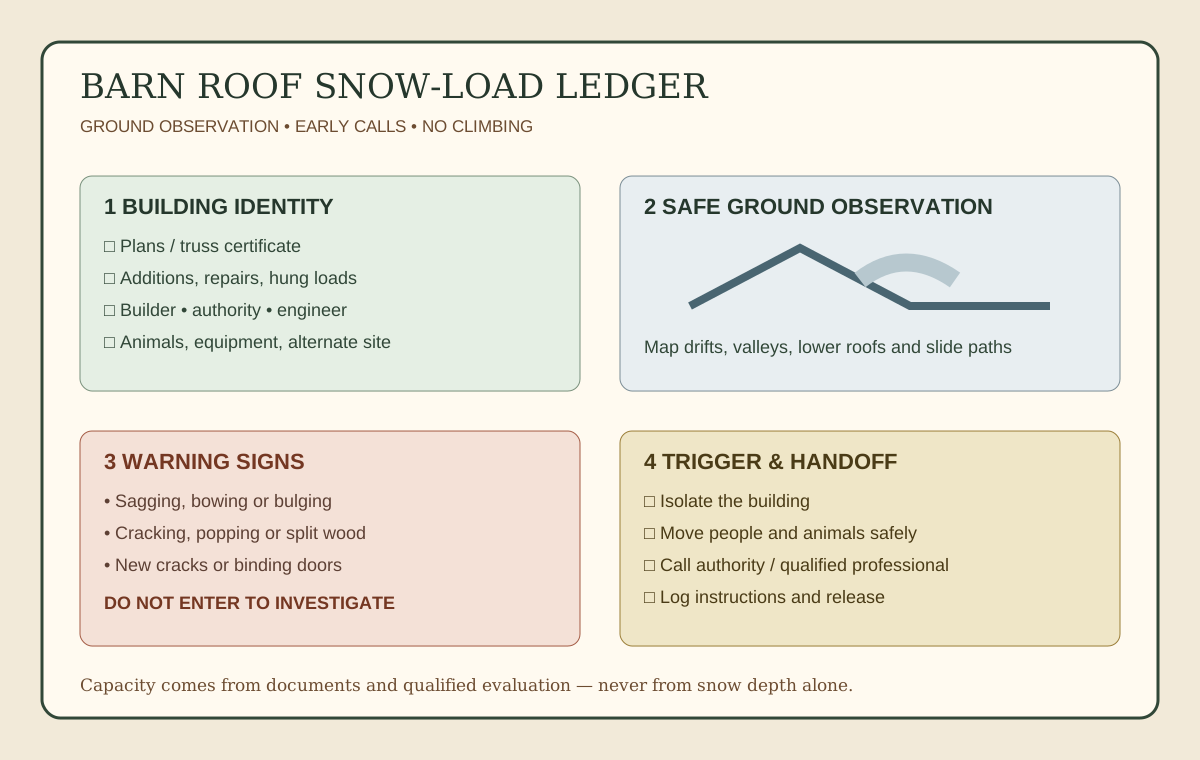
“How many inches can the roof hold?” sounds practical because depth is easy to see. It is the wrong measurement to use by itself. Light dry snow, wet snow, ice and rain-soaked snow can have very different weights at the same depth. Wind can scour one roof plane and pile a deep drift against a step, valley, ridge, parapet or piece of equipment. Snow sliding from a taller roof can concentrate on a lower addition. The building may also have changed since it was designed.
The useful winter record begins before the storm. It identifies what is known about the structure, what remains unknown, where loads may concentrate, who has authority to evaluate it and where animals or equipment can go if the building is restricted. During a storm, it limits the household to observations that can be made without climbing, entering a questionable structure or standing in a fall zone.
This page does not calculate roof capacity, certify a building or authorize snow removal. Never climb onto a roof, use a ladder, enter a building with possible structural distress, or stand below eaves and slide paths to complete this ledger. If warning signs appear or collapse is suspected, keep people and animals out, call emergency services or the local authority when conditions warrant, and use a structural engineer or other qualified professional. FEMA says roof-snow removal should be performed by qualified individuals using proper safety procedures.
Depth is an observation, not a capacity verdict
FEMA's snow-load guidance treats the decision as a building and load problem, not a simple depth threshold. Weight depends on the water contained in the snow; distribution depends on wind, roof geometry and nearby obstructions. Rain can add weight and ice can block drainage. A weather station away from the farm cannot describe a drift on one roof plane.
The other half of the equation is the structure. A design load shown on approved plans or a truss certificate has meaning only in the context of that design. Additions, removed braces, damaged connections, decay, corrosion, suspended heaters, feed systems, solar equipment or prior repairs may affect performance. Agricultural buildings can also fall outside the assumptions people make from houses. Do not copy a number from a neighboring barn, an online chart or a remembered rule of thumb.
Write “unknown” when capacity documents are missing. Then list the local building authority, original builder or truss supplier if known, insurer and structural professional who can help resolve the gap. An honest blank is safer than a confident guess.
Create one identity card for every structure
A farm with a barn, equipment shed, loafing shed, greenhouse and high tunnel has five different roof systems. Give each a short identifier that also appears on the farm emergency map. Photograph each elevation from a repeatable safe location before snow begins. Record the date and the person who took the photographs.
Building identity / verify before winter
- Structure name, map identifier and street-side orientation
- Current use, normal occupancy and animals or equipment inside
- Year built, additions and major repairs, if known
- Roof shape, roof steps, valleys, lean-tos and adjoining taller roofs
- Plans, truss certificate, inspection records and documented design criteria
- Bracing, connections or structural elements changed since construction
- Suspended, rooftop or ceiling-mounted equipment and its documentation
- Known leaks, corrosion, decay, vehicle impact or previous storm damage
- Builder, truss supplier, building authority, insurer and structural contact
- Alternate shelter or storage location and person responsible for opening it
Do not remove covers or climb to find a label. Gather records from files and suppliers. If a professional evaluates the structure, attach the written findings and limitations instead of converting them into a homemade “safe depth.” Record any repair, its designer and completion date.
Draw the places where snow may concentrate
Copy the roof outline onto the ledger. From safe ground, mark roof steps, valleys, lower additions, roof-mounted equipment, vents, gutters, drains and locations where snow from an upper roof could land. Note the prevailing winter wind and the sides that typically collect drifts. Include doors, gates, animal exits, electrical service and overhead lines, but keep observation points outside likely slide and collapse zones.
University of Minnesota Extension notes that roof pitch and geometry affect snow accumulation. Lower roofs can receive snow from upper roofs, valleys collect material and drifting creates uneven loads. A straight, unobstructed roof may behave differently from a complex roof with additions. This map gives a professional useful context and helps the household avoid hazardous approaches.
Choose two or three fixed photo points. After a storm, take photographs only when those points remain safe and accessible. Note the time, precipitation type, wind direction, temperature trend and whether rain or thaw followed snow. A photograph series can reveal a growing drift without pretending to measure its weight.
Establish a dry-weather baseline from the ground
Before winter, look along the roofline and sidewalls from the fixed points. Record whether they appear straight and whether doors and windows operate normally. Photograph visible exterior bracing, connections and prior repairs only from ordinary occupied areas that are already safe. Note cracks, displaced siding, bulging walls, water staining, corrosion or damaged posts that need professional attention.
UMN recommends checking truss certificates and joints and watching for movement, cracking and dry rot in animal facilities. Penn State emphasizes that bracing and connections matter to the performance of agricultural structures. These are reasons to arrange an evaluation, not prompts for a household to diagnose or repair a structural system.
Baseline notes need neutral wording: “south wall appears straight from photo point B” or “east door closed freely on October 28.” Avoid “sound,” “safe” or “good for 40 pounds” unless that exact conclusion comes from a qualified professional in a written record.
Use three response levels
| Level | What the ledger shows | Household action |
|---|---|---|
| Routine watch | No new distress observed from safe ground; weather and drift pattern recorded. | Keep routes clear, update photos and compare only with the documented baseline. |
| Professional check | Capacity is unknown; roof configuration creates a persistent drift; repairs or deterioration are unresolved; weather is adding wet snow, ice or rain. | Restrict discretionary access and contact the building authority, insurer or structural professional before conditions become urgent. |
| Evacuate and isolate | New sag, bowing, bulging, splitting, cracking, abnormal noises, binding doors/windows or another sign of structural distress. | Do not enter. Move people and animals only by a route that does not expose them to the building; call emergency services/local authority as appropriate and a structural professional. |
Evacuation should not depend on finding a clipboard during a storm. Post the alternate animal location, trailer and gate keys, halters or panels, feed and water plan, medication record and responsible contacts beside the map. Practice a low-stress move in safe weather. The first-freeze water audit can identify whether the alternate location has a reliable winter water source, while the outage dependency map covers powered doors, pumps, ventilation and lighting.
Know the warning signs without going looking for them
FEMA P-957 lists warning signs that can accompany structural distress: sagging roof or ceiling elements, bowed truss members, cracked or split wood, new cracks in walls or masonry, doors and windows that no longer operate normally, and popping, cracking or creaking sounds. UMN also calls out a roofline that is no longer straight, sidewall bulges and failed knee braces.
These signs matter only when they are noticed from an already safe place. Do not walk into a barn to inspect the underside of a roof after hearing an abnormal noise. Do not open a binding door to see what changed. Do not approach a bulging wall for a closer photograph. Leave, prevent entry and pass the observation to emergency responders or the evaluating professional.
If the building sounds different, looks different, or a door suddenly binds during a snow event, do not go inside to investigate. Move away from the building, keep others out and make the planned calls.
Plan animal movement before access becomes dangerous
Animal evacuation adds time, gates, handling risk and exposure. Mark a destination that is far enough from the questionable building and from falling snow, debris, overhead lines and emergency access. Confirm fencing, ventilation, bedding, water and species separation. Keep medication and identification records portable. Do not tether animals beside the building or block the route responders need.
Decide which animals can be moved by one person and which require a second handler, panels or a trailer. Write an early trigger based on an official warning, professional recommendation or loss of safe access. Waiting for obvious deformation can leave no safe route. If the route passes under eaves or beside a wall, choose another route before winter.
For poultry, the alternate plan must also manage moisture and airflow; use the winter chicken-coop ventilation ledger to avoid trading a roof concern for poor air quality. For livestock, keep daily feed and water quantities on the move sheet so the temporary site can operate without memory.
Treat greenhouses and high tunnels as separate structures
High tunnels and greenhouses may use light frames, flexible film, rigid panels or glazing. Penn State notes that Quonset-style high tunnels can collapse under heavy wet snow and that Gothic or peaked shapes shed snow more readily. Shape is not a capacity certificate. The manufacturer's site-specific installation, anchoring, bracing and snow-load documentation still govern.
Record the manufacturer, model, manual, installed spacing, anchoring, covering and any modifications. Map where snow can slide from nearby buildings or drift against end walls. List heat, inflation fans, vent motors and alarms on the outage dependency map. Do not add improvised interior posts, attach new loads, heat the structure with an unapproved appliance or alter bracing based on an online anecdote. Ask the manufacturer or a structural professional for a written solution.
Do not turn removal into the next emergency
FEMA warns that snow removal can injure workers and damage the roof. Falls, overhead electrical lines, hidden skylights, slippery surfaces and falling snow are hazards. Removing snow from only one area can create an unbalanced condition. Sharp tools and mechanical equipment can damage roofing, and people working beneath a distressed structure are exposed to collapse.
The ledger's job is to start the call early. Record which qualified contractor or professional will decide whether removal is needed, how the area will be isolated and who can move animals first. Keep their phone number and the structure identity card together. A roof rake in the equipment list does not establish that a person, access route or building is safe.
Never try to melt roof snow with open flame, an unapproved heater or redirected exhaust. Do not chip ice, strike roofing, climb with a shovel, attach a rope to the structure or place makeshift supports under a loaded roof. Sudden or uneven changes can make a dangerous condition worse.
Run the ledger after each meaningful weather change
- Read the forecast and official local alerts. Note snow type, wind, rain and temperature changes.
- Confirm people, animals and equipment can reach the alternate location without passing through a hazard zone.
- From the fixed safe photo points, record visible drift patterns and exterior changes. Skip the observation if the point is unsafe.
- Compare with the baseline photographs; never enter to confirm a suspected change.
- Use the three response levels. Call early when capacity is unknown or weather is increasing a known concentration.
- Record restrictions, calls, professional instructions and the person who received them.
- After the event, keep restrictions in place until the appropriate authority or professional releases the building.
Also document blocked vents, drains, emergency exits and access roads from safe locations. These can become operational problems even when the structure shows no obvious distress. Photograph damage for the insurer only after emergency and structural authorities say access is safe.
Close the season with records, not memory
At thaw, compare the first and last photographs. Log leaks, displaced roofing, damaged gutters, loose connections visible from safe areas, doors that changed operation and repairs recommended by a professional. Save invoices, stamped plans, truss documents and inspection letters with the identity card. Update the emergency map if animal locations, entrances or utilities moved.
Prioritize permanent corrections identified by the building authority or structural professional before adding storage or suspended equipment. A repair designed for one member may depend on bracing and connections elsewhere. Keep the written scope, materials and completion record so the next owner or caretaker does not have to reconstruct the building's history.
Questions from the winter file
How much snow is too much on a barn roof?
There is no universal safe depth. Snow density, ice, drifting, rain, roof geometry, deterioration and the building's documented capacity all matter. Use plans, a truss certificate, the local building authority or a structural professional rather than a generic depth rule.
Can I calculate roof load from snow depth?
Not from depth alone. Equal depths can have very different weights, and drifts create uneven loads. A professional evaluation must consider the site, weather, roof and actual structure.
Should I rake the barn roof myself?
Roof-snow removal is hazardous and can create an unbalanced load. FEMA advises that qualified individuals perform removal using proper safety procedures. Do not climb onto the roof or enter a building that may be unstable.
What signs mean we should evacuate?
Cracking or popping sounds, sagging roof or ceiling elements, bowing members, split wood, new wall cracks, bulging walls, or doors and windows that suddenly bind are warning signs. Keep people and animals out and contact emergency services or the local authority as conditions require, plus a structural professional.
Sources
Reviewed October 28, 2026. Local codes, the building's documented design and a site-specific professional evaluation control structural decisions.
- FEMA — Snow Load Safety Guide.
- FEMA P-957 — Snow Load Safety Guide.
- University of Minnesota Extension — Prevent roof collapses from snow and ice (reviewed 2026).
- University of Minnesota Extension — Caring for your horse in winter.
- Penn State Extension — Design and Build Dairy Structures for a Long Useful Life (updated 2025).
- Penn State Extension — High Tunnel Production.
- FEMA P-2055 — Post-disaster Building Safety Evaluation Guidance.